Written by S5107481

Trainspotting (1996) is a film directed by Danny Boyle and is an adaptation of the novel written by Irivine Welsh of the same name. The film stars Scottish actor, Ewan McGregor who portrays Mark Renton, a heroin addict. This essay will explore the cultural and social context of Trainspotting and why it became one of the most cultural films in the 90s. This critical analysis will explore heavily on the theme of drug use and how the film links with Scottish identity. We follow Renton throughout the film and discover more about the drug culture in Scotland and how it personally affected him.
Set in Edinburgh, Mark Renton is a middle-class heroin user who attempts to quit heroin. We are also introduced to his dysfunctional friends, Sick Boy, Spud, Begbie and Tommy who (apart from Tommy and Begbie), are also heroine user. Trying to get clean, Renton tries to get clean multiple times throughout the film, however his friends somehow always ends up back at his side, thus causing more problems for Renton throughout the narrative. Although the group does various activities together, they frequently take heroin with each other.
The film aimed to reflect Scotland during the late 1980s and expand on the urban side of Scotland. When representing Scotland in films, the target audiences are typically aimed for American viewers rather than the people of Scotland themselves so that the films can get international success. Although the film was an international success, Scotland resonated with the film in a more personal level. It was voted the best Scottish film of all time in 2004 via a general public poll.
From the language to the setting, the film resonates close to a lot of Scottish people’s heart as they see a cultural portrayal of themselves on the screen. When Trainspotting was released, Scotland’s is represented as a gritty location rather than a place full of Scottish history and culture. Because of this, us as the audience see a more realistic and current representation of Scottish people in the 1980s. A lot of slangs, Scottish dialect and even hints of Football culture is used/shown throughout the film that helped solidify the culture of Scotland.
David Martin-Jones (2009, p.24) stated in his book that Scottish films ‘deploys their comedic elements to construct an ‘edgy’ comedy, designed to make audience laugh, whilst dealing with serious issues that are perhaps more recognisable.’ Martin-Jones later said that comedy was a vital part in Scottish filmmaking with Bill Forsyth’s film, Gregory’s Girl (1981) that helped bring Scottish cinema into mainstream cinema (2009). One of the reasons why Trainspotting resonated well with its Scottish audience is because of the comedic elements that was deployed, such as Spud’s job interview while under the influence of amphetamine. While the comedic side of the scene can be seen, Danny Boyle shows the repercussion of drug use in the scene, as Spud didn’t get a call back due to his behaviour while on amphetamine.
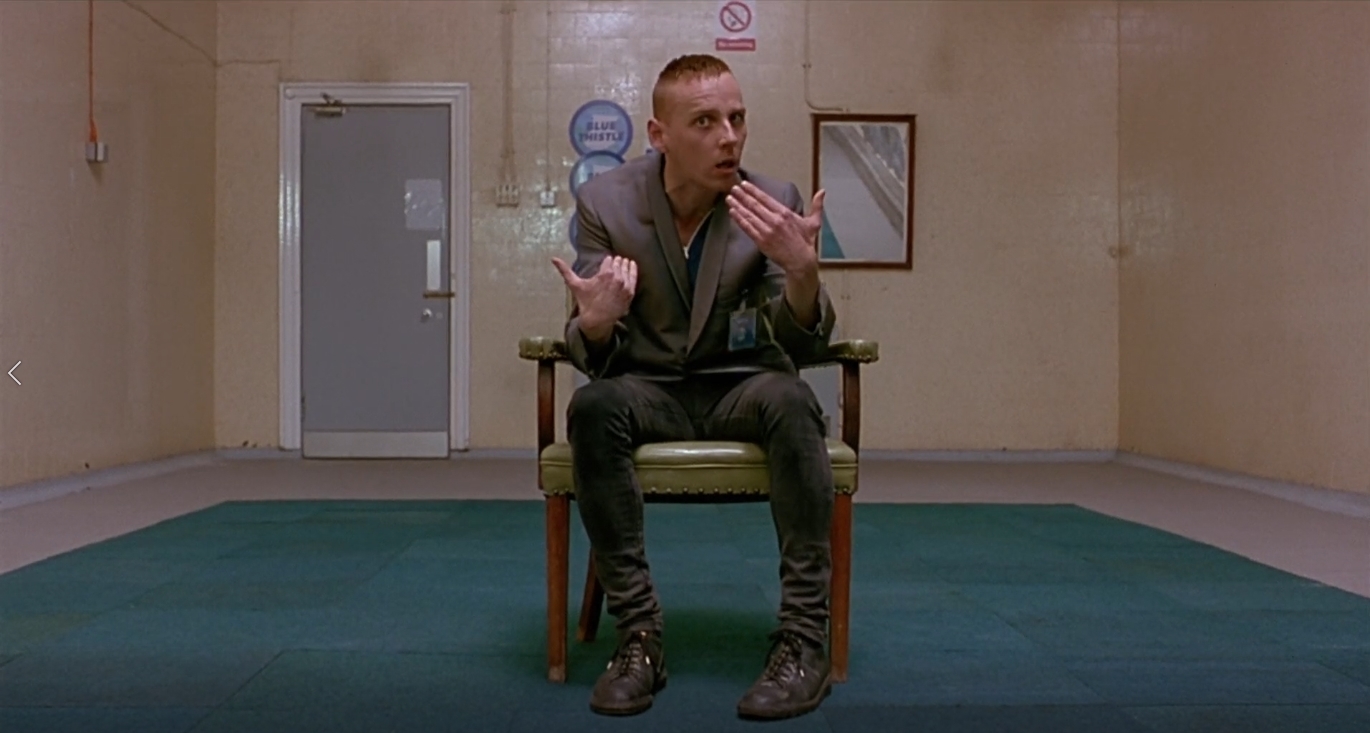
Although Trainspotting has many scenes of the characters doing drugs with Renton even describing heroin as ‘the best orgasm you ever had, multiply it by a thousand and your nowhere it.’ However, the film does not glamorise it as they show multiple consequences of drug use. Consequences is a major theme throughout the film and Boyle shows that it affected many of the characters.
This is significant with the character Tommy, who out of the group didn’t contribute to doing drugs and is portrayed to the audience as the most responsible of the friendship group. This changed when his girlfriend broke up with him. Needing to escape from reality, he decides to do heroin. Throughout the film, we see a change in Tommy physically and mentally which eventually lead to his death from toxoplasmosis. Another example is when the group was taking heroin with their friend Allison. During the session, her child died due to her getting high. This had an impact on Sick Boy who was implied heavily to be the father.


One of the most iconic lines ‘choose life’ was said by Renton during his monologue at the start and end of the film. The way he delivers it contrasts each other which shows a change in his character. At the start of the film, he addresses many goals people wanted, including ‘choose life’, in a sarcastic manner as he views life as pointless and that heroin is what he ultimately chose. However, after overdosing and nearly dying as well as Tommy’s death, Renton finally realises he needed a real fresh start and to go clean for good. By the end of the film, he wanted to be normal, even addressing the audience stating he wanted to be like them. Renton is viewed as a cult hero by the Scottish people in real life because of how and why he overcame his addiction. This raises the question on why many people in Scotland at that time was taking drugs at the first place.
In the 1979, Margaret Thatcher was elected as Prime Minister and declared many new policies such as the Rights to Buy, that affected many Scottish people. In a BBC article, they showed that during Thatcher’s reign, unemployment gradually increased from 1980 all the way to 1993. It was stated by Michael Fry in an article that Edinburgh was responsible for creating most of the world’s opiate drugs which included heroin. Coincidentally, at the same time, an arrival of cheap heroin from Pakistan also reached the streets of Edinburgh. The government of England and Wales reported that the use of heroin increased the 1980s to the early 1990s. They claimed that the ‘epidemic spread from area to area but the national peak occurred between 1993 to 2000,’ (Morgan, 2014). Although the reports are predominantly focused on England and Wales, Scotland’s statistics has also been linked in the reports relating to the heroin epidemic. With all these contributing factors, Scotland was dominated by lower to middle classed citizens with some being unemployed and living in poverty. This led to Scottish people taking heroin so that they can escape their reality due to them not being great. It could also suggest that at the time, people were taking drugs to rebel against the government.
As mentioned earlier, the theme of consequences is shown throughout the film. People take drugs and know the consequences that they can face. They do heroin because they enjoy it. In an article, John Arlidge spoke to Alan, an addict who stated that “There’s nothing here (Scotland). When life is as bad as this, heroin gives life; it becomes life” (Arlidge, 1996). Arlidge said he sees Alan as a character in Trainspotting and this links in well with Scottish identity because the portrayal of characters, especially Renton, are so relatable to many Scottish people. Trainspotting has birthed a generation of Scottish identity, one that they can relate to because the film gave them a voice. A voice to argue on why they did drugs. A voice on how Thatcher have damaged their nation.
It got to the point where Scottish people have accepted their reality of living in the middle to lower class. There is a scene where Renton needed to go to the toilet. He fantasies about having the best toilet the world can provide him such as ‘brilliance gold taps’ however, accepted the fact that he needed to go to the worst toilet in Scotland. The mise en scene itself can reflect Renton and other drug addict’s life during the 80s to 90s. The scene emphasises that Renton’s life is essentially a dump however, when Renton takes a swim inside the toilet, instead of mucky water, he finds himself swimming happily in a deep blue sea. This is important as it foreshadows Renton’s future decision to change, to evolve into a new Scottish identity that the government wants its people to be. The blue water is prominent as it is the colour of the Scottish national flag and Scottish people are shown tobe very patriotic to their country. Trainspotting has become a big influence on the people of Scotland, that the media such as Vice and The Guardian have named them the ‘Trainspotting generation.’


The author Irvine Welsh said in an interview that his ‘books are about transition’ (2019). In the film adaption of Welsh’s book, Trainspotting has shown a huge transition from the opening monologue to the last. The theme of transition is littered throughout the course of the film. This can subtlety be found in the choice of music used in the film. The film’s music starts off with the genre of rock music such as Iggy Pop’s song, Lust For Life. The genre of rock usually connotates to rebellion and in Renton’s case, it is against life and society.
After going through withdrawal, Renton meets up with Diane Coulston, a teenager who Renton had sex with earlier in the film. She talked about how everything is changing, from the music to the drugs. Renton realises that he needed to change himself, as he is living a meaningless life controlled by drugs. The next scene, we see him move to London so that he can have a fresh start. Electronic music then starts playing predominantly as soon as Renton moved to London and only goes back to punk rock when Renton is back with his friends. This can emphasis Renton’s change from being a rebellious character and evolving into an identity that fits in well with the government’s agenda, as previously mentioned in the toilet scene. By the end of the film, Underworld’s ‘Born Slippy’, an electronic song, starts playing while Renton walks away with the money away from his ‘friends.’ The change of genre in music reflects the change in society and most importantly, Renton’s identity. In a way, the film encourages the Scottish identity to evolve itself and to look at the future instead of looking for more drugs.

Mark Renton and Diane talking about change in soceity
Although part of United Kingdom, England and Scotland have always had their differences in the past due its proximity. Scotland has a rich history of being a proud country and see themselves as rivals with the English. Arttu Vilmi said that Welsh’s Trainspotting book England and Englishness against Scotland and Scottishness (Vilmi, 2014). When the film Braveheart (1995) came out, Mel Gibson represented Scottish identity as the underdog to their counterpart, the English. We see a binary opposition between England and Scotland again, with Scotland portraying the hero while the English are the villains. Like David and Goliath, the Scottish won back their land by the end of the film. Braveheart portrays the very best aspect of Scottish identity and gives the people of Scotland something to be proud of. In contrast, when Trainspotting was released a year later, it goes against all the stereotypes of Scottishness represented in Braveheart.
It was during the scene where Renton ranted back at Tommy, who the latter said, ‘Doesn’t it make you proud to be Scottish?’ Renton then screamed back ‘Its shite being Scottish, we’re the lowest of the low, the scum of the Earth.’ At first glance, this scene felt as if being Scottish wasn’t a great thing. In an article, Douglas Greenwood (2017) said that ‘Patriotism is a strange thing for Scottish people. It’s a mix of self-loathing and self-love.’ Renton attacks the idea of how the world thinks that modern Scotland’s identity is the same identity that was represented in Braveheart. 12 hours after the rant, Renton, Sick Boy and Spud decided to drop sobriety and start heroin again after releasing how meaningless life is in Scotland at that time. It was at this point of the film where Tommy also started to try heroin. Renton’s speech itself refers to Thatcher’s reign as Prime Minister as he said, ‘we ruled by effete arseholes.’ In truth, Renton spoke from his hearts about his opinions on Scotland. It was Renton’s honesty about Scotland that made Scottish people relate to the film.

Renton ranting about Scotland. https://www.youtube.com/watch?v=29-LRuuqFT0
It is easy to see why Trainspotting is classed by many Scottish people to be one of the best Scottish film and for critics to say that it is generation defining. Trainspotting not only portrayed the worst of Scotland, but it gives a clear message to Scottish identity on why they need to change, to move forwards away from drugs and to start a better life like Renton. Although consequences of drug use are displayed throughout the film, Boyle wanted the characters to have real reasons to do heroin but not to the point of glamorising. Because of its realistic portrayal of urban Scotland, the film gave a voice and an identity to the trainspotting generation, to speak up against the government. The treatment and neglections during the Thatcher era have caused many problems and the film is a platform for the people of Scotland to ask for change. The quote ‘Choose life’ is then popularised throughout Scotland as they want to evolve just like Renton did.
Although Welsh’s book was already popular in Scotland, Danny Boyle’s film helped spread the real Scotland onto mainstream cinema and with that it gained international success. The film itself helped Ewan McGregor onto many different roles in the future thus making him one of Scotland’s recognisable actors. After 21 years, Danny Boyle created T2 Trainspotting (2017), which sees the aftermath of Renton coming back to see his friends after many years since running away with the money.

References
- Braveheart, 1995, [Film] Directed by Mel Gibson, US, Icon Productions
- Greenwood. D, how trainspotting schooled a lost generation of scots in the power of patriotism, 2017, Vice, Available from: https://i-d.vice.com/en_uk/article/papy3b/trainspotting-scotland-patriotism-impact, [Accessed May 16th 2019]
- Louisiana Channel, 2019, Irvine Welsh Interview: My Books are about Transition, [video, online] Available from: https://vimeo.com/311193865, [Accessed May 16th, 2019]
- Martin-Jones, D, Scotland: global cinema: genres, modes and identities, 2005, Edinburgh: Edinburgh University Press
- Morgan, N, The heroin epidemic of the 1980s and 1990s and its effect on crime trends-then and now, 2014, GOV.UK, Available from: https://www.gov.uk/government/publications/the-heroin-epidemic-of-the-1980s-and-1990s-and-its-effect-on-crime-trends-then-and-now, [Accessed May 16th 2019]
- N/A, 2013, The Thatcher years in statistics [online], BBC, Available from: https://www.bbc.co.uk/news/uk-politics-22070491, [Accessed May 16th, 2019]
- Trainspotting, 1996. [Film] Directed by Danny Boyle, UK, Channel Four Films
- Vilmi, A, Identity and Image in Irvine Welsh’s Trainspotting, 2014, University of Oulu.
- Welsh. I, 1993, Trainspotting, Secker & Warburg
Bibliography
- Edermariam. A and Scott.K. What happened to Trainspotting generation? 2009, The Guardian, Available from: https://www.theguardian.com/society/2009/aug/15/scotland-trainspotting-generation-dying-fact , [Accessed May 16th, 2019]
- Gregory’s Girl, 1981. [Film], Directed by Bill Forsyth, UK, Scottish Television
- Shelter Scotland, Scotland’s housing crisis, [online], Available from: http://www.scotlandhousingcrisis.org.uk/scotlands_housing_crisis/, [Accessed May 16th, 2019]
- White. S, Punk as a Rebellion, Arkade, Available from: http://www.arkade.com/content/Content/Recent+Articles/Punk+as+a+Rebellion, [Accessed May 16th, 2019]


 S5107481- Critical Analysis